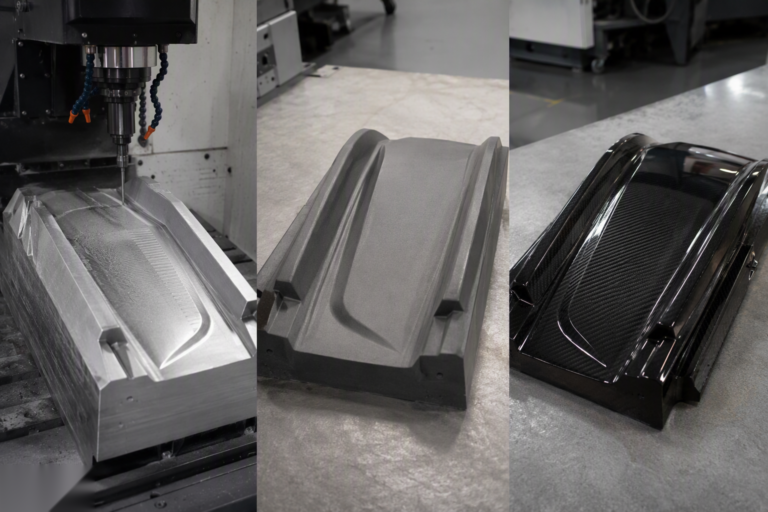
In carbon fiber manufacturing, the mold is where quality is decided. Two factories can use the same fabric and the same resin — but the one with better tooling makes the better part, every single time.
Because we design and machine our molds in-house at JC AUTOCARBON, clients often ask us: which mold type do I need, what does it cost, and how long will it last? Here are honest answers.

[IMAGE 1 | Position: below this intro | Prompt: “Close-up photo of a CNC milling machine cutting a large aluminum mold block for a car part, metal chips flying, coolant spraying, bright machine-shop lighting, photorealistic industrial photography” | Alt: “CNC machining an aluminum carbon fiber mold”]
The Four Mold Types We Use
Rapid Prototype Molds
Made from resin or composite materials, built fast and cheap. They exist to answer one question: is the design right?
Cost: lowest
Life: small production runs only
Best for: design validation, show cars, market testing
CNC Aluminum Molds
Aluminum machines quickly and conducts heat well, so parts cure faster. It is the workhorse for development and medium-volume production.
Cost: mid-range
Life: medium volumes with good maintenance
Best for: medium-volume production, parts needing good surface quality
P20 Steel Molds
Pre-hardened tool steel — tougher, more stable, and much longer-lasting than aluminum, at a higher price and longer machining time.
Cost: higher
Life: high-volume, high-precision programs
Best for: long-term production where consistency over thousands of parts matters
Autoclave-Ready Composite Molds
Special composite molds designed to survive repeated autoclave heat and pressure cycles for prepreg (dry carbon) production.
Cost: varies with size and precision
Best for: dry carbon parts cured under heat and pressure
Which Mold Should You Choose?
Match the mold to your total production volume, not your first order:
Your plan | Recommended mold |
|---|---|
Validate a design, 1–10 pieces | Rapid prototype mold |
Launch a product, tens to hundreds of pieces | CNC aluminum mold |
Long-term program, high volumes | P20 steel mold |
Dry carbon / autoclave production | Autoclave-ready composite mold |
A common and costly mistake: buying a production-grade steel mold before the design is proven. Start one step cheaper, validate, then upgrade.
How Long Can One Mold Be Used?
Mold life depends on five things:
- Mold material — resin/composite molds suit smaller runs; aluminum and steel suit higher volumes
- Product structure — deep draws and sharp details wear a mold faster
- Curing temperature — repeated high-temperature cycles age molds
- Production process — compression molding stresses a mold more than vacuum infusion
- Maintenance — cleaning, storage, and surface care extend life significantly
Because we maintain molds in-house, we track wear and repair before problems reach your parts.
What Does a Carbon Fiber Mold Cost?
Mold cost scales with part size, precision, and material. A small prototype mold may cost a fraction of a large steel production mold. We quote molds individually after reviewing your 3D data — and we will always tell you if a cheaper mold can do the job.
Do Mold Modifications Cost Extra?
It depends on why the change is needed:
Our side
If a confirmed production issue requires modification, we handle it according to the agreed project responsibility
Your side
Design changes or new requirements after tooling approval may carry additional cost
This is why we push hard on design review before cutting metal: changes on a screen are free; changes in steel are not.
Why In-House Tooling Matters to You
Many “manufacturers” outsource molds. We do not. In-house mold development means:
FAQ
Have a part that needs tooling?
Send us your 3D files — we will recommend the right mold type and quote both the mold and the parts.