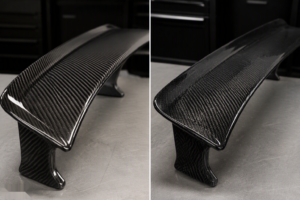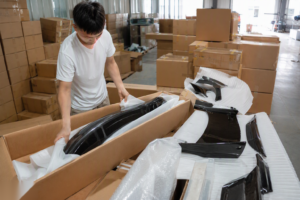
“Will it fit?” is the question that decides whether a carbon fiber order ends in a five-star review or an expensive return. Poor fitment is the number one complaint in this industry — gaps, misaligned holes, parts that need a hammer to install.
Fitment is not luck. It is a chain of controls, and at JC AUTOCARBON we manage every link. Here is exactly how.

Step 1: Start From the Real Car — 3D Scanning
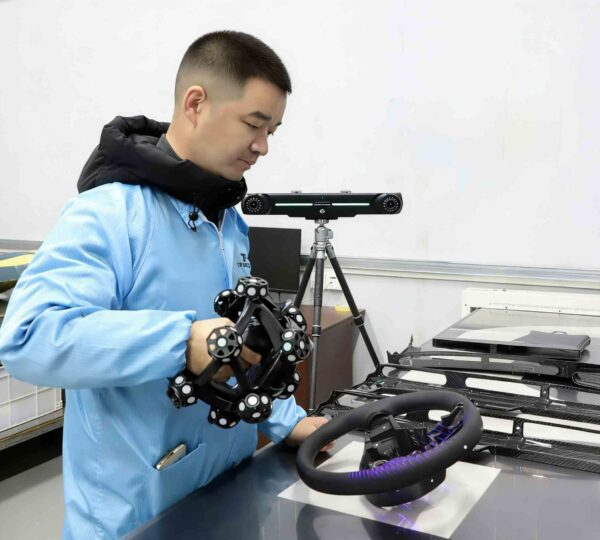
We never design from photos or guesses. Our team 3D-scans the original vehicle or OEM part, capturing the exact surface data — every curve, edge, and mounting point — as a digital model accurate to fractions of a millimeter.
Need scanning outside our region? Our teams travel worldwide for on-site scanning, from single-model projects to large-scale scanning programs.
Step 2: Reverse Engineering and CAD Comparison
Scan data becomes a precise CAD model. Before tooling, we compare our design against the original vehicle data point by point — the part is engineered around the car, not approximately around it.
This is also how we recreate discontinued or rare parts: scan the original, rebuild the data, and produce an accurate carbon fiber replacement.
Step 3: Precision Molds — Where Fitment Is Locked In
A part can only be as accurate as the mold it comes from. Our CNC-machined molds hold ±0.3 mm on most applications. Because molds are made in-house, the same engineers who reviewed your data control the tooling that produces your parts.
Step 4: Mounting Points and Trial Fitting
Before shipment, we verify:
A part that passes our checks installs like the factory piece — no drilling, no forcing, no filler.

Step 5: For Aero Parts — CFD Before We Cut Anything
For performance parts — rear wings, splitters, diffusers, full aero kits — looks are only half the job. The part must also work at speed.
JC AUTOCARBON provides CFD (Computational Fluid Dynamics) simulation as an engineering service. Before prototyping, we can evaluate:
CFD turns “this wing looks fast” into data you can show your customers. It is an additional engineering service, charged based on project complexity — and far cheaper than discovering a problem after production.
What If a Fitment Problem Still Appears?
We stand behind our work. If you report a fitment issue:
- Send us installation photos, videos, and vehicle details
- Our engineers review whether the cause is manufacturing, shipping, or installation
- If the deviation is from our side, we take responsibility under the agreed after-sales policy — repair, replacement, or other solutions
Because every production batch is documented, we can trace any part back to its mold, materials, and inspection records.
FAQ
Want parts that actually fit?
Send us your vehicle model and part list — we will show you the scan data and fitment checks behind every piece.
Want to keep reading? Browse the full Resource Center for more articles, installation guides, and pricing insights from the factory.
Author: He Dong
He Dong has spent 20+ years doing what he loves most — making cars and bikes faster, sharper, and better looking.
As an Automotive & Motorcycle Engineering Specialist, he’s worked on everything from engine builds and chassis tweaks to track machines and custom aftermarket projects. If it has wheels and an engine, he’s probably taken it apart and made it better.
These days he focuses on the aftermarket world, where good engineering meets real-world budgets — and he’s not shy about calling out parts that look great in photos but don’t perform.
This blog is where he shares what’s worked, what’s failed, and what he’s learned along the way. Honest, hands-on advice, straight from someone who’s done the work himself.