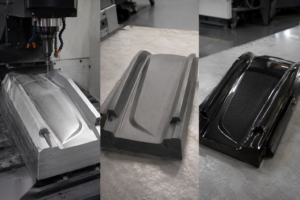
Quick answer: “Kevlar vs carbon fiber” is really three questions — which is stronger, what each one costs, and what carbon Kevlar hybrid fabric actually is.
Carbon fiber wins on stiffness (2–6× stiffer by elastic modulus) and structural rigidity. Kevlar wins on impact energy absorption and fracture resistance.
Raw Kevlar fiber actually costs more than standard carbon fiber: $15–25/lb vs $10–20/lb.
And carbon Kevlar — the black-and-gold hybrid fabric — combines both materials in a single weave.
We manufacture parts in carbon fiber and carbon-Kevlar hybrid, so here is the full comparison with real numbers — plus when the hybrid fabric is the right answer.

What Are These Materials, Actually?
Carbon fiber is made of carbon atoms aligned in a graphitic crystal structure along the fiber axis. That alignment produces extreme stiffness — elastic modulus of 200–800 GPa at the fiber level — but also brittle failure: under overload it fractures suddenly, without warning deformation.
Kevlar is DuPont’s brand name for para-aramid synthetic fiber. Its polymer chains can stretch and rotate before breaking — failure elongation of 2.5–4.0%, more than double carbon fiber’s ~1.5%.
Kevlar absorbs energy strand by strand instead of releasing it all at once. That’s why it’s the default material for ballistic armor.
The headline: carbon fiber fails stiff and sudden; Kevlar fails soft and gradual. Everything in the comparison flows from that.
Kevlar vs Carbon Fiber: The Data Table
Property | Kevlar (Aramid) | Carbon Fiber | Who Wins & When |
|---|---|---|---|
Tensile Strength | 3.0–3.6 GPa | 3.5–6.0 GPa | CF — pure tension loading |
Elastic Modulus (Stiffness) | 60–120 GPa | 200–800 GPa | CF — structural rigidity, 2–6× stiffer |
Compressive Strength | Only ~20–30% of tensile | High | CF — Kevlar can’t carry compression structures |
Elongation at Break | 2.5–4.0% | ~1.5% | Kevlar — impact & energy absorption |
Density | 1.44 g/cm³ | ~1.60 g/cm³ | Kevlar slightly lighter raw; CF parts lighter at equal stiffness |
Impact Resistance | Excellent | Low (brittle, hidden delamination) | Kevlar — repeated/sudden impact |
UV Stability | Poor — degrades without coating | Excellent | CF — long-term outdoor exposure |
Electrical Conductivity | Non-conductive | Conductive | Kevlar — radomes, EMI-sensitive builds |
Machinability | Difficult — edges fray, holes inconsistent | Moderate — brittle but predictable | CF — precision trimming & drilling |
Temperature Limit | Degrades above ~500°C | Fiber stable far beyond resin limits (~120°C+ for parts) | CF for sustained heat |
Raw Material Price | $15–25/lb | $10–20/lb | CF is the cheaper raw input |
Is Kevlar Stronger Than Carbon Fiber?
Depends on the definition of “stronger”:

The stress–strain curves show why the failure modes differ. Carbon fiber carries more load per unit of deformation, but the curve ends suddenly at ~1.5% strain. Kevlar peaks lower but keeps absorbing energy more than twice as far before it lets go — which is exactly what you want in an impact zone.

For the automotive structural parts we manufacture, carbon fiber is the correct primary material.
Real FEA validation on a carbon fiber roof crossbeam showed 87% higher bending stiffness and 163% higher peak bending load than the metal equivalent, at 40% less weight — numbers Kevlar simply cannot deliver in a structural role.
Kevlar vs Carbon Fiber vs Fiberglass
Fiberglass is the third material buyers usually weigh against these two. It is the budget baseline of the composites world: heavier and much less stiff than either, but cheap, easy to repair, and tolerant of flexing. Here is the three-way view:
Property | Fiberglass (E-glass) | Kevlar (Aramid) | Carbon Fiber |
|---|---|---|---|
Tensile Strength (fiber) | ~3.4 GPa | 3.0–3.6 GPa | 3.5–6.0 GPa |
Stiffness (Modulus) | ~72 GPa | 60–120 GPa | 200–800 GPa |
Density | 2.55 g/cm³ | 1.44 g/cm³ | ~1.60 g/cm³ |
Impact Resistance | Good | Excellent | Low |
UV Stability | Good | Poor | Excellent |
Raw Material Price | $1–3/lb | $15–25/lb | $10–20/lb |
The short version: fiberglass when budget rules and loads are modest, Kevlar when impact survival rules, carbon fiber when stiffness and weight rule.
Kevlar Properties: Quick Answers
The numbers people search for most, in plain terms:
How Much Does Kevlar Cost?
The price question has two layers, and the second one surprises people:
Raw fiber: Kevlar runs $15–25 per pound against $10–20 per pound for standard-grade carbon fiber. High-modulus aerospace carbon grades can exceed $45/lb, but at comparable industrial grades, Kevlar is not the budget option — it’s the more expensive raw material.
Total part cost: The gap widens further in production.
Kevlar resists clean cutting — CNC trimming produces frayed edges, drilled holes come out inconsistent, and finishing is manual.
That means higher labor cost per part and higher scrap rates. Carbon fiber processes through mature, automatable routes (prepreg, RTM, HP-RTM) with consistent dimensional quality at scale.
In our own production, for any volume above prototype quantities, carbon fiber is typically cheaper per finished part — despite Kevlar’s reputation as the “affordable” alternative. For an even lower-cost natural-fiber route, see our flax fiber vs carbon fiber comparison.
Carbon Kevlar: The Hybrid Fabric Explained
Search carbon kevlar and you’ll find the two materials woven together into hybrid fabrics — the classic black-and-gold pattern. This is not a third material; it’s a deliberate combination, and it exists because some parts need carbon’s stiffness and Kevlar’s impact survival at the same time.

What Is Carbon Kevlar Fabric?
Carbon Kevlar fabric is a hybrid weave: carbon fiber tows and Kevlar aramid tows interlaced in one cloth.
A typical construction runs 3K carbon in the warp direction and 1500-denier Kevlar in the weft, or alternates the two bundles to form the checkerboard pattern.
The gold lines are the aramid fiber itself — that color is intrinsic to the polymer, not a dye.
Weave Patterns and What They Change
Pattern choice is functional, not just cosmetic. Twill drapes better over complex molds — it’s the default for curved panels like fenders and bumpers.
Plain and checkerboard weaves are more dimensionally stable and suit flat or gently curved panels.
The Kevlar bundles also mark the impact-tolerant direction: orient them where stone chips and debris actually hit.

Why Hybrid Parts Exist
Woven hybrid fabric is only one way to combine the two materials. The other is a hybrid laminate — separate plies of each, stacked in an engineered sequence:
The real-world case: performance car hoods.
Carbon provides the rigid, lightweight structure; a final Kevlar backing layer prevents catastrophic fragmentation or detachment under high-speed aerodynamic stress.
This carbon-Kevlar architecture is one reason many composite parts pass strict European safety certifications (TÜV and similar).
Hybrid laminates aren’t a compromise — they’re engineered answers to parts that must be stiff and impact-survivable. But the ply sequence must be designed for the actual load case; layering the two materials randomly gets you neither material’s full benefit.
Kevlar vs Carbon Fiber for Car Parts
This is where the comparison stops being academic. On a car, the right material follows the load case of each part:
In our own shop, pure carbon handles the structural and cosmetic parts, and we reach for the carbon-Kevlar hybrid layup on parts that live in the impact zone — front lips, splitters, and underbody-adjacent pieces.
It costs more per part, but it comes back from a hit that would total a pure carbon piece.

See what this looks like in practice: carbon fiber hoods, front lips, and rear spoilers built with these layups.
Kevlar vs Carbon Fiber: Which Should You Choose?
Choose carbon fiber when:
Choose Kevlar when:
Choose a carbon-Kevlar hybrid when both failure modes exist in the same part — the most technically correct answer for performance automotive bodywork, and increasingly common in quality hood and body kit construction.
Application | Best Material | Why |
|---|---|---|
Structural body panels (hoods, wings) | Carbon fiber | Stiffness, weight, surface finish |
Impact zones (splitters, bash guards) | Kevlar or hybrid | Energy absorption, gradual failure |
Safety-critical enclosures | Kevlar | Won’t shatter on failure |
Radar / electronics housings | Kevlar (or fiberglass) | Non-conductive, signal-transparent |
Budget non-structural parts | Fiberglass | Lowest cost, easy repair |
Premium performance bodywork | Carbon-Kevlar hybrid | Stiff outside, tough inside |
Kevlar vs carbon fiber — frequently asked questions
Common questions when choosing between Kevlar, carbon fiber, and carbon Kevlar hybrid fabric.
The Bottom Line
Kevlar vs carbon fiber is a failure-mode question: carbon resists bending and carries structure; Kevlar absorbs impact and refuses to shatter.
Carbon is stiffer, cheaper per finished part, UV-stable, and machinable. Kevlar is tougher, non-conductive, and fails safely.
And when a part needs both? That’s what carbon Kevlar hybrids are for — stiffness outside, toughness inside.
Want stiffness and impact protection in one part? JC AUTOCARBON builds carbon fiber and carbon-Kevlar hybrid parts — see our carbon fiber hoods, or read the carbon fiber hood installation guide.
Want to keep reading? Browse the full Resource Center for more articles, installation guides, and pricing insights from the factory.
Author: He Dong
He Dong – Automotive & Motorcycle Engineering Specialist, has spent 20+ years doing what he loves most — making cars and bikes faster, sharper, and better looking.