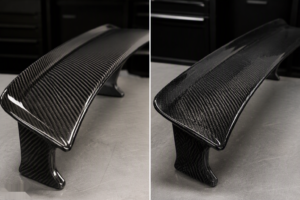
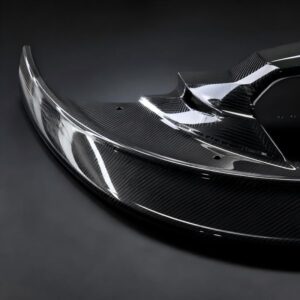
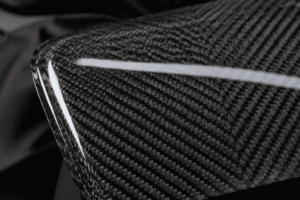
Carbon fiber is a very powerful material, high strength, low weight, resist high temperature and corrosion, so its price is also not cheap. In the market there are often bad sellers who sell fake goods to buyers that not understand carbon fiber. This article will detail compare real and fake carbon fiber, teach everyone a simple method to tell real or fake, help you avoid being cheated.
What Is Real Carbon Fiber?
Real carbon fiber is not “a coating”, it is a structural material. It is made by thousands of carbon filaments in each bundle, diameter only about 5–10 microns, woven into cloth, then combined with epoxy resin and cured. Its value is not on the surface pattern, but the material itself: weight only about one quarter of steel, but strength is several times of steel, also resist high temperature, anti creep, thermal expansion coefficient very low.

How Real Carbon Fiber Is Made
Take car modification parts as example, the mainstream high quality process is pre-preg + autoclave curing (dry carbon fiber): workers lay the resin-pre-impregnated carbon cloth into mold layer by layer by hand according to design, vacuum it and put into autoclave, cure under high temperature and high pressure. This process can push out the air bubbles between layers, make the fiber and resin ratio reach ideal state (usually about 60:40), the finished part is dense, high rigidity, weave deep and clear.

The lower-end process is wet layup (wet carbon fiber): lay the cloth and brush resin at same time, cost is lower, but easy to have resin stacking, weave crooked, overweight problems. Not saying cannot use, but quality really much lower than dry carbon.

Common Types of Real Carbon Fiber Weaves
- 2×2 Twill: most common classic pattern, diagonal crossing, strong 3D feeling, fit curved surface very well, most car exterior parts use this weave.
- Plain Weave: one over one under checkerboard pattern, structure stable but more stiff, more suitable for flat parts.
- Forged Carbon: use chopped carbon fiber and resin pressed in mold, shows irregular marble pattern. It has no continuous weave, but it is also real carbon fiber, often used for complex shape parts.


Factory tip
No matter which pattern, the common point of real carbon fiber is: the fiber is woven, not printed. Rotate the part under light, the weave will have light and dark flowing 3D depth feeling, printing process cannot copy this.
What Is Fake Carbon Fiber?
“Fake carbon fiber” is more crude than you imagine. These fakes only have similar appearance with carbon fiber (of course, the beauty is also far worse than real carbon fiber), no carbon fiber structure. What you get from buying fake carbon fiber is only a look that is 70-80% like real, you cannot buy the performance.
Common Fake Carbon Fiber Materials
- Carbon fiber sticker / vinyl wrap: stick the PVC film printed with weave on plastic or metal part surface. The edge will lift up, will bubble when heated, after one or two years basically totally ruined, and the hardness and strength also not enough to support the need.
- Hydro-dip: float the film printed with carbon fiber pattern on water surface, the part goes into water and pattern transfers on it, then spray clear coat on surface. From far it can look like real, it is a type of fake with low price and real-looking appearance, widely used on cheap interior trims, steering wheel, phone case etc.
- Carbon pattern coated plastic / printed fiberglass parts: directly spray or press carbon pattern on plastic or fiberglass parts. Scratch the surface with fingernail, totally smooth, no any fiber touch feeling.
- Carbon veneer parts: only stick one thin layer of real carbon cloth on ABS plastic or fiberglass base. This is a kind that hard to tell, its surface is real carbon, can pass visual check even part of conductivity test, but inside structure is still plastic or fiberglass, strength and weight have no improvement.

How to Tell If Carbon Fiber Is Real? Real Carbon Fiber vs Fake: 7 Key Differences
1. Weight
Light weight is the meaning of carbon fiber existing. Same size, real carbon fiber part is obviously lighter than plastic part, much more lighter than metal part. Take sports car rear spoiler as example, real carbon fiber version usually only 1.5–4 kg, but ABS plastic fake often weight 4–8 kg. The weight difference in your hand is more obvious than you think. If you feel the “carbon fiber” part you bought is heavy, basically can confirm it is fake.
2. Weave Pattern & Depth
Rotate the part against the light and see the gloss:
- Real carbon fiber: like a sunken ship under water, real carbon texture sinks under the surface clear coat, rotate against light, you can see the texture with different gloss from different angles, the texture refracts light and produces many small light-dark surfaces, these surfaces keep changing when rotating.
- Fake carbon fiber: fake carbon essentially is a sticker, a printed sheet. So against light, its surface is flat, rotating will not have light-dark change, and every corner, every bending place detail exactly same, will not have the tiny spacing difference like real fabric, touch it also smooth like paper.
3. Price Difference
The cost structure of real carbon fiber decides it cannot be cheap. The price of one real carbon fiber car interior trim is usually several times of fake. If seller writes “carbon fiber style”, “carbon fiber finish”, “carbon texture” in product description, instead of clearly marking “100% Pre-Preg Carbon Fiber” or “Dry Carbon Fiber”, then no need to think, all fake.
4. Sound & Feel
Use knuckle or coin lightly knock the center of the part, real carbon fiber will make a crisp “ding” sound with a little metallic feeling, this is the character of high rigidity composite material transferring vibration; plastic fake is dull “dong dong” sound. Touch the surface with finger, real carbon fiber can feel the slight up and down of fabric going two directions, fake is smooth like glass.
5. Heat Resistance
Carbon fiber itself can bear very high temperature, car-use epoxy resin system usually can also resist about 90–175°C (200–350°F) without deformation. Use hair dryer hot wind blow the fake part, plastic skin will soften, bubble even melt, but real carbon fiber will not move at all. Note: open flame burning is destructive test, only suitable for scrap pieces, never try on finished product.
6. Strength & Durability
Use both thumbs press the unsupported area of the part: real carbon fiber almost no deformation, very rigid; plastic fake will obviously bend and bounce back. Long term use difference is more obvious: real carbon fiber with anti-UV clear coat can keep gloss many years, but vinyl wrap and hydro-dip parts under strong sunlight usually fade, bubble, peel in one or two years.
7. Backside & Edges
Flip over and look at the backside and edges, this is the most reliable structural check method:
- Real carbon fiber: backside also shows smooth fabric texture, cutting edges and mounting holes can see multi-layer fiber stacked cross-section.
- Vinyl wrap / hydro-dip parts: backside is just normal plastic, edge can see the layer separation between film and plastic.
- Veneer parts: edge or screw holes will expose the inside white, gray ABS or fiberglass base material.

Advanced check
Conductivity test Carbon fiber itself conducts electricity, but all fake materials (vinyl wrap, hydro-dip, fiberglass, ABS) are insulators. Set multimeter to continuity mode, two probes touch two points about 5 cm apart on surface: real carbon fiber will beep and conduct (typical resistance about 10–100Ω), fake goods no reaction at all. Note the clear coat layer on finished product surface is not conductive, maybe need lightly scratch or use probes to poke through the paint layer.
Real Carbon Fiber vs Fake: Price & Value Comparison
Dimension | Real carbon fiber (dry carbon / pre-preg) | Hydro-dip / vinyl wrap | Carbon veneer |
|---|---|---|---|
Material structure | Full thickness carbon cloth + resin composite | Plastic/metal base + printed pattern | Surface carbon cloth + inside plastic/fiberglass |
Weight | Very light (about 1/4 of steel) | Same as base material, no weight reduce | Slightly reduced or no change |
Strength / rigidity | High, can bear load, can use for structural parts | No improvement | Decided by inside base material, improvement limited |
Durability | With anti-UV clear coat can use many years | Fade, bubble, peel in 1–2 years | Surface okay, base material easy aging |
Typical price level | High (3–10 times of fake) | Very low | Medium, often sold pretending as high price real carbon |
How to spot it | —— | Flat static pattern, not conductive | Edge cross-section shows base material, heavier |
Is Fake Carbon Fiber Ever Worth Buying?
When Fake Carbon Fiber Is Fine
If you only want the visual effect of carbon fiber, use on pure decoration parts that bear no force at all, like show car interior trim pieces, desk ornaments, phone case, then you can choose hydro-dip or vinyl wrap parts. Fakes that honestly mark “carbon fiber style” on the page itself have no problem, the wrong is sellers who sell fakes at real carbon price.
When You Should Always Buy Real
Any parts that involve structural force and safety, please choose real carbon fiber without hesitation: spoiler, front lip, hood under 120 km/h speed need to bear tens of kilograms aerodynamic load, once plastic fake breaks and falls off at high speed, the result cannot imagine; steering wheel, shift mechanism and other parts related to personal safety same logic. Weight reduction need (unsprung mass, car body weight balance) also only real carbon can satisfy.
Where to Buy Real Carbon Fiber Parts
FAQ
Not sure which process fits your project?
Send us your part drawings or a sample
Our engineering team will review it and recommend the most cost-effective route.
Decided carbon fiber is the right call? Browse our carbon fiber body kits & aero packages, or look up your vehicle in the brands & models directory.
Want to keep reading? Browse the full Resource Center for more articles, installation guides, and pricing insights from the factory.
Author: He Dong
He Dong – Automotive & Motorcycle Engineering Specialist, has spent 20+ years doing what he loves most — making cars and bikes faster, sharper, and better looking.