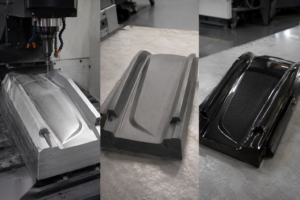
In carbon fiber manufacturing, the mold is where quality is decided. Two factories can use the same fabric and the same resin — but the one with better tooling makes the better part, every single time.
Because we design and machine our molds in-house at JC AUTOCARBON, clients often ask us: what exactly is a carbon fiber mold, which type do I need, what does it cost, and how long will it last?
Here are honest answers from a factory floor, not a marketing brochure.

What Is a Carbon Fiber Mold?
A carbon fiber mold (also written “carbon fibre mould”) is the precision tool that gives a carbon fiber part its final shape, surface, and dimensional accuracy while the resin cures.
Carbon fiber fabric or prepreg is laid into or onto the mold, then consolidated under heat and pressure. Whatever the mold’s surface looks like — gloss, texture, waviness, tolerance — the cured part will copy it.
That is why carbon fiber mold tooling is treated as an engineering discipline of its own: the mold must hold tight dimensions through repeated heating and cooling cycles, resist resin chemistry and release agents, and survive hundreds or thousands of demoldings without losing surface quality.
Carbon Fiber Molding Processes — and the Tooling Each One Needs
Can you mold carbon fiber? Yes — but how you mold it decides what tooling you need. The four mainstream processes place very different demands on the mold:
Process | How it works | Tooling requirement | Best for |
|---|---|---|---|
Hand lay-up / vacuum bag (wet carbon) | Dry fabric is laid into the mold and impregnated with resin, then consolidated under vacuum | Composite or aluminum molds; moderate temperature resistance | Prototypes, custom and low-volume parts |
Compression molding | Prepreg or compound is placed in a heated matched mold and pressed; typical mold temperatures 120–180 °C | Steel molds (P20/718/H13) with heating channels and venting | Medium to high volume, consistent quality |
RTM (resin transfer molding) | Dry preform in a closed mold; resin injected under pressure | Rigid matched molds with sealing and injection ports | Complex parts, good surfaces on both sides |
Autoclave (dry carbon / prepreg) | Prepreg lay-up cured under heat and pressure inside an autoclave | Autoclave-ready composite, Invar, or aluminum molds that survive repeated 120–180 °C cycles | High-end dry carbon parts, motorsport, aerospace |

Most of our production parts are made by vacuum-assisted processes and autoclave curing, so the mold types below are the ones we actually build and run every week.
The Four Mold Types We Use
1. Rapid Prototype Molds. Made from resin or composite tooling board, built fast and cheap. They exist to answer one question: is the design right?
2. CNC Aluminum Molds. Aluminum machines quickly and conducts heat well, so parts cure faster and cycles stay short. It is the workhorse for development and medium-volume production.
3. P20 Steel Molds. Pre-hardened tool steel — tougher, more stable, and much longer-lasting than aluminum, at a higher price and longer machining time. For very high volumes or mirror-finish parts, we move to harder steels such as 718 or H13.
4. Autoclave-Ready Composite Molds. Special composite molds designed to survive repeated autoclave heat and pressure cycles for prepreg (dry carbon) production. A well-made dry carbon mold can be polished and reused 300+ times, versus roughly 100–200 parts for a typical wet carbon mold.
Mold type | Cost level | Typical life | Best for |
|---|---|---|---|
Rapid prototype (resin/composite) | Lowest | Tens of parts | Design validation, 1–10 pieces |
CNC aluminum | Mid-range | Hundreds of parts | Launch production, good surface |
P20 / 718 / H13 steel | Higher | Thousands of cycles | Long-term, high-volume programs |
Autoclave composite | Varies | 300+ cure cycles (dry carbon) | Dry carbon / autoclave production |

Which Mold Should You Choose?
Match the mold to your total production volume, not your first order:
Your plan | Recommended mold |
|---|---|
Validate a design, 1–10 pieces | Rapid prototype mold |
Launch a product, tens to hundreds of pieces | CNC aluminum mold |
Long-term program, high volumes | P20 steel mold |
Dry carbon / autoclave production | Autoclave-ready composite mold |
A common and costly mistake: buying a production-grade steel mold before the design is proven. Start one step cheaper, validate, then upgrade.
What Makes a High-Precision Carbon Fiber Mold
As a high precision carbon fiber molds manufacturer, we judge tooling by five things — and so should you:

How We Build Your Mold: From 3D Data to First Article
Every mold goes through the same in-house chain — which is also why we can promise a standard 58-day first-sample cycle:

How Long Can One Mold Be Used?
Mold life depends on five things:
From our own daily production: a wet carbon composite mold typically delivers around 100–200 parts, a dry carbon autoclave mold 300+ cycles, and a well-maintained steel mold runs into the thousands. Because we maintain molds in-house, we track wear and repair before problems reach your parts.

What Does a Carbon Fiber Mold Cost?
Mold cost scales with part size, precision, and mold material. As a rough guide from the industry: a small prototype mold may cost a fraction of a large steel production mold, and a complex dry carbon tooling set costs more than a simple wet carbon mold — but the mold is a one-time investment that pays for itself across every part it produces.
We quote molds individually after reviewing your 3D data — and if a cheaper mold can do the job, we will tell you.
Do Mold Modifications Cost Extra?
It depends on why the change is needed:
This is why we push hard on design review before cutting metal: changes on a screen are free; changes in steel are not.
Why In-House Tooling Matters to You
Many “manufacturers” outsource molds. We do not. In-house mold development means:
How to Choose a Carbon Fiber Mold Manufacturer
If you are comparing carbon fiber mold tooling manufacturers, ask five questions before you send any 3D data:
We built our own tooling shop precisely because these are the questions we would ask. You are welcome to ask them to us.
FAQs

Have a part that needs tooling? Send us your 3D files — we will recommend the right mold type and quote both the mold and the parts. Looking for finished parts instead of custom tooling? Browse our carbon fiber parts catalog.
Want to keep reading? Browse the full Resource Center for more articles, installation guides, and pricing insights from the factory.
Author: He Dong
He Dong – Automotive & Motorcycle Engineering Specialist, has spent 20+ years doing what he loves most — making cars and bikes faster, sharper, and better looking.