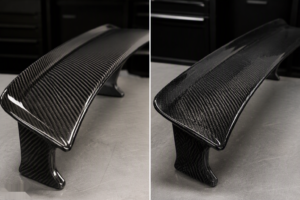
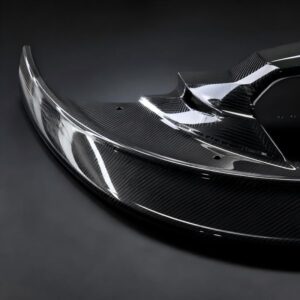
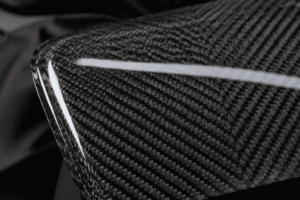
Maybe everyone already see too many rough comparisons between carbon fiber and traditional steel, but not familiar with the detail comparison of carbon steel and carbon fiber under the steel category, also many people will mix up carbon fiber and carbon steel.
Actually, carbon fiber and carbon steel is two totally different materials, their density, strength and other properties have big difference, the processing ways are completely different, and the application directions also mostly not overlap. Choosing wrong material will make the product overweight, over budget, even cause safety hidden danger.
As a manufacturer focusing on R&D and production of carbon fiber automotive parts, engineers of JC AutoCarbon get asked the same question by customers every day: “For this part, should I use carbon steel or carbon fiber?” In this article, we will from the material manufacturer’s view, use data and actual application experience to explain this question clearly for everyone.

Carbon Steel vs Carbon Fiber at a Glance
Property | Carbon Steel | Carbon Fiber (CFRP) |
|---|---|---|
Material Type | Iron-carbon metal alloy | Carbon filaments + resin composite |
Density | ≈ 7.85 g/cm³ | ≈ 1.5–1.8 g/cm³ (about 4–5× lighter) |
Tensile Strength | ≈ 400–1,200 MPa (mild to high-strength grades) | ≈ 600–3,500 MPa (laminate, layup-dependent) |
Strength-to-Weight Ratio | Low to medium | Very high — typically several times that of steel |
Stiffness (Elastic Modulus) | ≈ 200 GPa, uniform in all directions | 50–300+ GPa, tunable by fiber orientation |
Directionality | Isotropic (same in every direction) | Anisotropic (strongest along the fibers) |
Corrosion Resistance | Rusts without coating or treatment | Does not rust; ideal for wet and outdoor use |
Failure Behavior | Ductile — bends before it breaks (visible warning) | Brittle — can crack or delaminate suddenly |
Fatigue Resistance | Good, but degrades over repeated cycles | Excellent under properly designed loading |
Repairability | Weldable, easy field repair | Requires bonded patch repair or part replacement |
Material & Manufacturing Cost | Low; mature stamping and welding supply chain | High; tooling, layup labor and cure cycles |
Typical Applications | Frames, brackets, tools, construction, chassis | Body panels, hoods, splitters, monocoques, UAVs |
What Is Carbon Steel?
Carbon steel is a kind of steel, it is an alloy made of iron and carbon, carbon content usually between 0.05%–2%. Although its name starts with “carbon” like carbon fiber, it still a kind of metal essentially , and has no relation with carbon fiber in production process.
According to the carbon content, carbon steel can be divided into low carbon steel, medium carbon steel and high carbon steel. The higher carbon it contents, the higher hardness and strength it can be, but it will also be more brittle.
The reason why carbon steel is always the absolute main force of industry for more than one hundred years, rely on four hard strengths:
- Cheap (raw material and processing technology both extremely mature)
- Good toughness (when impacted it first deform instead of directly break, giving visible warning signal)
- Easy to process (stamping, welding, cutting, machining all have mature supply chain)
- Repairable (just weld it then can continue use)
But its shortcoming also obvious: density as high as about 7.85 g/cm³, which is 4–5 times of carbon fiber composite; and if not do galvanizing or coating treatment, in humid environment it will rust very fast, need continuous maintenance.

What Is Carbon Fiber?
Carbon Fiber (CF for short) is a high-performance fiber material made from organic precursor fibers such as polyacrylonitrile (PAN) or pitch, through a carbonization process at high temperature in an inert environment.
Its carbon content is usually above 90%, and can even reach as high as 99%. The diameter of a single carbon fiber filament is only about 5-10 microns, almost one tenth of a human hair.

Inside, the carbon atoms are highly parallel arranged in crystal form along the long axis of the fiber, forming a hexagonal ring-shaped graphitized structure. It is this stable structure that gives carbon fiber components extremely high strength.
Carbon fiber, just as its name implies, not only has the functional characteristics of carbon materials, but also has the soft characteristics of textile fibers, making it extremely malleable.
The tensile strength of carbon fiber is 5-10 times that of ordinary steel, but its density is only about 1/4 of steel (about 1.5-2.0 g/cm³). Compared with steel of the same weight, the structural strength of carbon fiber is much higher.
Extremely high strength and extremely light weight—the combination of these two makes carbon fiber material almost perfect.
In addition, carbon fiber also has the advantages of high elastic modulus, excellent corrosion resistance, high temperature tolerance (above 2000°C in non-oxidizing environments), and extremely low thermal expansion coefficient. It is not easy to deform even when temperature changes rapidly from high to low, which is the icing on the cake for this material.
In the market, fiber bundles formed by collecting thousands of filaments are commonly used.

These fiber bundles can be used alone, or can be woven into carbon fiber cloth, or can be composited with matrix materials such as resin, metal, and ceramics to make carbon fiber reinforced polymer (CFRP). Among them, carbon fiber reinforced polymer (CFRP) is currently the most widely used form, accounting for more than 90%.
This kind of composite material not only fully retains the core advantages of carbon fiber such as high strength, high modulus, and low density, but also has the forming convenience and corrosion resistance of the matrix materials. It is an ideal choice to replace traditional metal materials.
Because of these outstanding advantages, carbon fiber is called “the king of new materials” and “black gold” by the industry, and is widely used in aerospace, automobile manufacturing, wind power energy, sports and leisure, and high-end industrial fields. It has become an irreplaceable choice.

Is Carbon Fiber Stronger Than Carbon Steel?
This is the question we got asked most, the honest answer is: at same weight, carbon fiber is far stronger than carbon steel; but talking strength without working condition is meaningless. Let us look from several dimensions:
Strength Metric | Carbon Steel | Carbon Fiber (CFRP) |
|---|---|---|
Tensile Strength (absolute) | ≈ 400–1,200 MPa | ≈ 600–3,500 MPa along fiber direction |
Specific Strength (per unit weight) | Baseline | Typically 4–10× higher |
Strength Across Fibers (90°) | N/A (isotropic) | Drops sharply — layup design is critical |
Compressive Strength | High and forgiving | Moderate, layup-dependent |
Local Stress at Bolt Holes / Edges | Tolerates well | Requires reinforced insert and edge design |
Strength by Weight vs Strength by Volume
There is a common saying in the market: “carbon fiber is 5 times stronger than steel”, here actually means specific strength specific strength (strength ÷ density).
Take common engineering grades as example: T700 grade carbon fiber tensile strength about 4,900 MPa, density about 1.8 g/cm³; common structural steel Q235 tensile strength about 400 MPa, density 7.85 g/cm³.
After conversion, the pulling force that unit weight can bear, carbon fiber is several times of steel.
But if compare by volume, a thick steel beam still can carry bigger absolute load than a thin carbon fiber plate. So the correct question is not “who is stronger”, but “in my working condition, which material can be made lighter under the premise of meeting strength requirement”.
The Anisotropy Factor
Carbon steel is isotropic material: no matter force come from which direction, performance is same. Carbon fiber is anisotropic material: along fiber direction strong to amazing, perpendicular to fiber direction strength maybe only left a fraction.
This means carbon fiber parts need consider much more factors in design than carbon steel, fiber angle, layup number, inserts and edge reinforcement all need redesign. This is also the reason why choosing a carbon fiber manufacturer with engineering ability is more important than only comparing price.
Carbon Fiber vs Carbon Steel Weight: How Much Can You Save?
Weight is the place where two materials difference is big, also the place carbon fiber most valuable:
- Carbon fiber composite density about 1.5–1.8 g/cm³, carbon steel about 7.85 g/cm³, same volume about 4–5 times lighter;
- After redesign with same stiffness, carbon fiber parts usually 30%–60% lighter than steel parts;
- On car, the lightweight benefit of body panels, aero parts, battery pack shell etc. will directly turn into range, handling and acceleration performance.
Take one carbon fiber hood we produced as example: original steel hood about 14 kg, after replace with JC Autocarbon carbon fiber version about 5.5 kg, single part weight reduction over 60%. For electric car, every dozens kg reduced of whole vehicle, the range improvement it brings is real.
Stiffness, Fatigue and Corrosion: Long-Term Performance
Stiffness (Modulus of Elasticity)
Carbon steel elastic modulus about 200 GPa, and consistent in all directions, very “easy to predict”. Carbon fiber laminate modulus range very wide (50–300+ GPa), can “customize on demand” through layup design — lay more fibers in the direction need stiffness, keep flexibility in the direction need buffer. This kind of designability is what steel cannot give.
Fatigue Resistance
Under repeated alternating load, properly designed carbon fiber structure fatigue performance is better than steel, this is also the reason it widely used in drone arms, racing suspension and other high cycle fatigue scenes. Although steel toughness is good, but under long term cyclic load it will also produce metal fatigue crack.
Corrosion Resistance
Carbon fiber itself not rust, in humid, salt spray, outdoor environments basically maintenance free; carbon steel must rely on galvanizing, spraying and other surface treatment, and after coating damaged, rust will spread from the wound.
One detail need attention: carbon fiber direct contact with aluminum and other metals in humid environment may cause galvanic corrosion, when designing fasteners and inserts need do insulation isolation, we pay much attention to this problem when making related parts.
Impact Resistance and Failure Behavior
In the previous items basically carbon fiber is better, but carbon steel also have some advantages that carbon fiber cannot replace.
Behavior | Carbon Steel | Carbon Fiber (CFRP) |
|---|---|---|
Failure Mode | Ductile — yields and bends visibly before breaking | Brittle — cracks or delaminates, sometimes with hidden internal damage |
Impact Response | Absorbs energy through plastic deformation | Absorbs energy through controlled fiber breakage; high specific energy absorption but no plastic warning |
Inspection | Damage usually visible to the naked eye | May require tap test or NDT to detect internal delamination |
Repair | Weld and go | Bonded patch repair by trained technicians, or part replacement |
Carbon steel will bend obxiously after impacted. This can count as a damage alert, although the material damaged, but you at least know it has been damaged, you also can see the damaged position and severity roughly.
While carbon fiber may looks fine by the outside after sharp point imapct, but alrady broken and delaminated in the inside, you can’t tell if it has problem just by look at the surface of the carbon fiber part.
So, if you don’t change the damage parts in time, it will bring you some safety issue in the future. Therefore, we really should avoid sharp imapct when we put the carbon fiber part in daily use, and regularly give to manufacturer for inspection.
Despite that, there is no need to worry too much about this characteristic of carbon fiber, properly designed carbon fiber crash structure’s energy absorption per unit mass actually very excellent, for example supercar monocoque (Monocoque) exactly use this characteristic to protect passengers.
The design key is let impact force transfer along fiber direction, as long as engineer design the load path right then can get twice result with half effort.

Cost Comparison: Material Price vs Total Cost of Ownership
Cost also one of carbon steel’s advantages.
- Raw material: steel only a few dollars per kg; carbon fiber prepreg can reach dozens to over one hundred dollars per kg;
- Process: steel part stamping can come out one piece in a few seconds, carbon fiber need layup, bagging, curing, cycle basically counted by hours, and need skilled workers to operate;
- Mold: steel stamping mold expensive but life extremely long, suitable for large volume of hundreds thousands vehicles; carbon fiber mold relatively cheap but limited life, naturally fit small and medium batch and customization.
But purchasing also cannot only look at cost price, need look at the whole. If your car very need weight reduction, for example you want to improve electric car range, racing car lap time, drone flight time, logistics fuel consumption etc., then in this situation carbon fiber’s longer life cycle benefit can offset the initial material cost difference.
And when you don’t need consider body weight, only consider cost price, and need the car can be welded and repaired on site when damaged, at this time carbon steel is more suitable.
Carbon Steel vs Carbon Fiber by Application
Application | Carbon Fiber Advantage | Carbon Steel Advantage | Typical Recommendation |
|---|---|---|---|
Automotive body panels (hoods, fenders, roofs) | Weight savings, premium finish, no rust | Low cost, easy dent repair | CFRP for performance & EV models; steel for economy trims |
Light weight, complex shapes, motorsport look | Impact ductility | CFRP is the mainstream choice | |
Crash-critical structures | High specific energy absorption when engineered correctly | Predictable ductile deformation, regulation-proven | Depends on homologation; hybrid designs are common |
Motorcycle fairings & covers | Weight reduction, heat-resistant resin options | Lower cost | CFRP for fairings; steel/alloy for load-bearing frames |
Drone / UAV frames | Stiffness-to-weight ratio extends flight time | Low material cost | CFRP is usually the better choice |
Industrial brackets & tooling | Tailored stiffness, corrosion-free | Weldable, cheap, easy to modify on site | Depends on load, volume and budget |
Structural tubes & roll cages | High specific stiffness | Weldable, field-repairable, regulation-friendly | Steel for cages; CFRP for lightweight moving structures |


How to Choose: A Manufacturer’s Decision Guide
Below is the selection suggestions we provide:
- Weight sensitive → Carbon Fiber.
- As long as one kg lighter can bring actual benefit in range, speed, payload or handling, carbon fiber’s premium have chance to earn back;
- Budget first, large volume, need welding repair → Carbon Steel.
- No material can beat steel on cost;
- Humid, salt spray, outdoor maintenance-free scene → Carbon Fiber.
- Not rust means lower maintenance cost and longer service life;
- Sharp impact, rough loading, field emergency repair scene → priority consider carbon steel or Carbon Fiber/aramid hybrid solution;
- Decide to change to carbon fiber → Must Redesign, not just direct replacement without consider of thickness.
- Layup, wall thickness, inserts, edge reinforcement all need recalculate for fiber directionality, at this time find a manufacturer can provide professional customization support is reliable, only buying standard parts easy to have problem.
FAQ
Not sure which process fits your project?
Send us your part drawings or a sample
Our engineering team will review it and recommend the most cost-effective route.
Decided carbon fiber is the right call? Browse our carbon fiber body kits & aero packages, or look up your vehicle in the brands & models directory.
Want to keep reading? Browse the full Resource Center for more articles, installation guides, and pricing insights from the factory.
Author: He Dong
He Dong – Automotive & Motorcycle Engineering Specialist, has spent 20+ years doing what he loves most — making cars and bikes faster, sharper, and better looking.