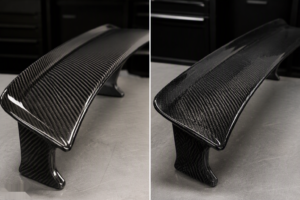
Quick answer: Yes — carbon fiber is stronger than aluminum where it counts, and aluminum is about 74% heavier than carbon fiber for the same volume (2.7 g/cm³ vs ~1.55 g/cm³).
But “stronger” needs unpacking, because tensile strength, stiffness, and strength-to-weight ratio are three different questions with three different answers.
We build carbon fiber parts for a living, so this guide gives you real numbers — material property data and a production FEA test on an actual automotive structural part — and an honest answer on when aluminum is still the right choice.
Before diving into the details of the comparison, let’s first take a look at a summary data table.
Metric | Carbon Fiber Composite | Aluminum Alloy | Winner |
|---|---|---|---|
Density | ~1.5–1.6 g/cm³ | ~2.7 g/cm³ | Carbon fiber (~42% lighter at the same volume) |
Tensile Strength | 755–861 MPa (laminate) | 310–572 MPa | Carbon fiber |
Elastic Modulus (Stiffness) | 63–90 GPa (laminate) | 68.9–71.7 GPa | Tie (carbon wins decisively per unit weight) |
Strength-to-Weight Ratio | ~3–5× aluminum | Baseline | Carbon fiber |
Impact Behavior | Brittle failure; internal delamination can be invisible | Dents and bends; damage is visible | Aluminum |
Thermal Conductivity | 5–10 W/m·K | ~205 W/m·K | Depends (aluminum for heat dissipation, carbon for insulation) |
Thermal Expansion (CTE) | 0.1–0.5 µm/m·°C | ~23.1 µm/m·°C | Carbon fiber (near-zero dimensional change) |
Continuous Service Temperature | 120–200°C (limited by resin) | Melting point ~660°C, but strength fades above 200°C | Aluminum |
Corrosion Resistance | Does not corrode; salt-, acid-, and alkali-proof | Protected by oxide film; still oxidizes and pits | Carbon fiber |
Galvanic Corrosion Risk | Accelerates aluminum corrosion on direct contact — insulation mandatory | Sacrificed when in contact with carbon | Tie (both need attention in hybrid builds) |
Fatigue Performance | Fatigue strength at 70–80% of tensile strength | Only 30–50% (6061-T6: ~96.5 MPa at 5×10⁸ cycles) | Carbon fiber |
Vibration Damping (NVH) | Vibration decays in ~2 seconds | ~9 seconds | Carbon fiber |
UV Resistance | Resin needs UV-stabilized formulation or clear coat | Essentially unaffected | Aluminum |
Raw Material Cost | ~$30–90/kg | ~$2–5/kg | Aluminum |
Production Throughput | Mold + layup + cure; hours per part | Stamped in under a minute | Aluminum |
Finished Part Price | 3–5× the aluminum equivalent | Baseline | Aluminum |
Repairability | Requires specialist materials and layup; often full replacement | Panel-beating and welding; any workshop can do it | Aluminum |
Recyclability | Difficult; recycling tech still maturing | Nearly 100% recyclable; recycled aluminum uses ~5% of primary energy | Aluminum |
Design Freedom | Directional strength via layup; complex shapes molded in one piece | Limited by stamping/welding; complex shapes need multi-part assemblies | Carbon fiber |

How Much Heavier Is Aluminum Than Carbon Fiber?
This is the most-searched question in this matchup, and it has a clean answer:
Material | Density | Relative Weight (same volume) |
|---|---|---|
Carbon fiber composite | ~1.5–1.6 g/cm³ | 1.0× (baseline) |
Aluminum alloy | ~2.7 g/cm³ | ~1.74× heavier |
~7.85 g/cm³ | ~5.1× heavier |
Aluminum is roughly 74% denser than carbon fiber composite. Put the other way: a carbon fiber part weighs about 42% less than the identical shape in aluminum — before any engineering optimization.
When a part is redesigned to exploit carbon’s directional properties (thinner walls, structural ribbing only where needed), real-world weight savings of 40–50% over the aluminum version are typical.
Why it matters on a car: every kilogram removed from unsprung or high-mounted mass (hoods, roofs, wings) improves acceleration, braking, and handling measurably — not just on a spec sheet.
Is Carbon Fiber Stronger Than Aluminum?
It depends which “strength” you mean. Here’s the honest data:
Property | Aluminum Alloy (typical 6061/7075) | Carbon Fiber (T300 UD, 0°) | Carbon Fiber (Twill Weave) |
|---|---|---|---|
Density | ~2.7 g/cm³ | 1.5 g/cm³ | 1.56 g/cm³ |
Tensile Modulus (stiffness) | ~70 GPa | 90.1 GPa | 63 GPa |
Tensile Strength | ~300–570 MPa | 861 MPa | 755 MPa |
Compressive Strength | ~250–500 MPa | 400 MPa | 517 MPa |
Corrosion | Oxidizes (slowly) | Does not corrode | Does not corrode |
Fatigue Behavior | Progressive cracking, no fatigue limit | Excellent cyclic resistance | Excellent cyclic resistance |

Real FEA Test: Same Part, Both Materials
Lab tables are one thing. Here’s what happened when our engineering team ran finite element analysis on a production automotive roof front crossbeam — identical geometry, identical bolt constraints, identical load points — in metal versus carbon fiber composite (HP-RTM, six-layer T300 layup, 3.5mm):
Performance Metric | Metal Crossbeam | Carbon Fiber Crossbeam | Difference |
|---|---|---|---|
Weight | 1.20 kg | 0.718 kg | −40.2% |
Axial Tensile Stiffness | 12,500 N/mm | 18,518 N/mm | +48.1% |
Bending Stiffness | 152 N/mm | 284.3 N/mm | +87.0% |
Peak Bending Load | 1,018 N | 2,681 N | +163.4% |
Constrained Modal 1st Frequency | 76.8 Hz | 122.7 Hz | +59.8% |
Read that table again: 40% lighter, 87% stiffer in bending, and it withstands 2.6× the peak load before failure. Higher modal frequencies also mean less vibration and better NVH behavior.
This is what “is carbon fiber stronger than aluminum” looks like when the answer is engineered rather than assumed.
The same test with a lazy layup — carbon swapped into an aluminum-designed geometry without re-engineering — would tell a much less impressive story. Fiber orientation for the actual load path is not optional; it’s where the numbers come from.
Thermal Performance Comparison
Besides the mechanical properties of carbon fiber and aluminum, thermal performance is also a decisive part in the material selection process, but many people often deliberately ignore this data.
Thermal performance is not simply “heat resistance”. It should be broken down into three more detailed dimensions: thermal conductivity, coefficient of thermal expansion, and continuous service temperature.
Thermal Metric | Carbon Fiber Composite | Aluminum Alloy |
|---|---|---|
Thermal Conductivity | ~5–10 W/m·K (close to an insulating material) | ~205 W/m·K (excellent heat conductor) |
Coefficient of Thermal Expansion | ~0.1–0.5 µm/m·°C (almost no expansion or shrinkage) | ~23.1 µm/m·°C |
Continuous Service Temperature | Limited by the resin matrix, ~120–200°C | Melting point ~660°C, but strength drops obviously above 200°C |
Thermal Conductivity Comparison
The thermal conductivity of aluminum is far higher than carbon fiber composite. This makes aluminum the correct material specification for heat sinks, brake cooling structures, and any component that needs to move heat away from the heat source quickly.
Carbon fiber composite has low thermal conductivity in the thickness direction and cannot conduct heat effectively, so it should not be selected when heat dissipation is a functional requirement.
Thermal Expansion Comparison
Aluminum has a relatively high coefficient of thermal expansion, which means its parts will show obvious expansion and contraction during temperature cycling.
Carbon fiber composite, depending on the fiber orientation, can achieve near-zero or even negative coefficient of thermal expansion in specific directions — this property makes it an indispensable material in aerospace structures and precision instruments, because these fields have strict requirements on dimensional stability under temperature change.
Performance that has been strictly verified, not only in theory: the carbon fiber intake parts produced by JCSPORTLINE passed the specified thermal pressure test — heated to 120°C and bearing 0.7 MPa (7 bar) of internal pressure — with no leakage and no structural damage as the result, which proves that carbon fiber composite systems can work normally in real operating environments.

Corrosion Resistance and Durability Comparison: Carbon Fiber vs Aluminum
Durability Dimension | Carbon Fiber Composite | Aluminum Alloy |
|---|---|---|
Basic Corrosion Resistance | Does not rust; resistant to salt spray, acid and alkali | Protected by oxide film, but still oxidizes and pits |
Galvanic Corrosion | Direct contact with aluminum accelerates corrosion on the aluminum side | Gets “sacrificed” when in contact with carbon fiber |
Fatigue Performance | Fatigue strength can reach 70–80% of tensile strength | Only 30–50% of tensile strength, no fatigue limit |
Damage Mode | Brittle failure; internal delamination may be invisible | Dents and bends; damage is visible to the eye |
Ultraviolet (UV) | Resin needs UV-resistant formulation or coating protection | Basically not affected |
Carbon fiber composite itself does not corrode. Whether in humid conditions or in salt spray, acid and alkali environments, it does not need any maintenance — on this point carbon fiber completely beats aluminum.
However, in actual applications there is a special situation: when carbon fiber is in direct contact with aluminum, a galvanic couple will form and accelerate the corrosion of aluminum.
Therefore, when using hybrid assemblies of carbon fiber and aluminum, insulating isolation is needed at the interface. This is an extra engineering requirement and will increase the complexity of the interface.

Cost and Processing Comparison: Carbon Fiber vs Aluminum
The price gap between carbon fiber and aluminum is across the board, extending from raw materials all the way to repair and recycling.
Cost Dimension | Carbon Fiber Composite | Aluminum Alloy |
|---|---|---|
Raw Material Price | ~$30–90/kg (depending on grade) | ~$2–5/kg |
Forming Process | Mold + layup + curing; hours per part | Stamping / casting / CNC; one part within a minute |
Repair | Needs professional materials and layup repair; often full replacement | Panel beating and welding is enough; ordinary workshops can fix it |
Recycling | Difficult to recycle; technology still at early stage | Nearly 100% recyclable; recycled energy use only ~5% |
From the raw material side, carbon fiber is about $30–90/kg, while aluminum is only $2–5/kg — the price gap is between 15 and 18 times.
In processing and manufacturing, the two pull apart an even bigger gap: aluminum can be machined, welded, extruded and formed with widely available equipment and labor. Tooling cost is lower. Prototype lead time is counted in days.
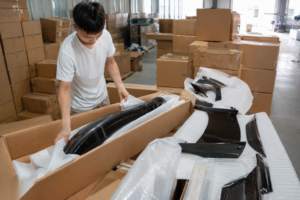
Carbon fiber, on the other hand, needs dedicated molds, autoclave or RTM processing equipment, and trained lamination technicians.
For low to medium volume structural parts, the total project cost of carbon fiber — including material, tooling, process and labor — is obviously higher than aluminum.
As production volume increases, the tooling cost gets amortized and this gap will shrink, but it will not disappear. Procurement teams need to look at the cost per kilogram, not the price of each part.
The gap on the recycling side is also very large. Aluminum can be recycled almost infinitely without any performance loss, and recycled aluminum only consumes about 5% of the energy of primary aluminum; while the problem of recycling and reusing carbon fiber materials is still not solved.
Although aluminum is better than carbon fiber in both cost and recycling, the maintenance cost of carbon fiber parts is extremely low, and the service life is much longer than aluminum.
Aluminum parts need regular anti-corrosion treatment instead.
The lifecycle cost gap can offset the purchase price gap in some cases — the specific situation still needs specific analysis.
Other Easily Overlooked Comparison Factors
Besides the aspects mentioned above, there are several dimensions that are easily overlooked during material selection consideration:
Vibration Damping and NVH.
The vibration damping of carbon fiber composite is far better than light metals. In actual tests, a light alloy structure needs about 9 seconds to stop vibrating, while carbon fiber composite only needs about 2 seconds to stop.
Higher natural frequency plus stronger damping means less resonance, noise and vibration fatigue, which can improve the driver’s experience.
Design Freedom.
Through layup design, carbon fiber can customize strength and stiffness in different directions, and complex curved surfaces can be integrally molded in one shot, which greatly reduces the number of parts and connection points.
Aluminum is limited by the stamping and welding processes — if you want to make a complex aerodynamic shape, you will need many parts to assemble together.
Where Aluminum Still Wins
We make carbon fiber, but a credible comparison doesn’t pretend aluminum is obsolete:
Carbon Fiber vs Aluminum: Which Should You Choose?
Choose carbon fiber when:
Choose aluminum when:
The smart middle ground — hybrid structures: many high-performance builds use carbon fiber for primary load surfaces with aluminum inserts and brackets at connection points, combining carbon’s efficiency with aluminum’s machinability at the joints.
(One engineering note: carbon and aluminum in direct contact create a galvanic couple that accelerates aluminum corrosion — insulating separation at interfaces is mandatory. How to attach carbon fiber to metal →)

Carbon fiber vs aluminum — frequently asked questions
Common questions when choosing between carbon fiber and aluminum parts.
The Bottom Line
Carbon fiber vs aluminum isn’t a fight with one winner — it’s a matching exercise.
Carbon fiber delivers roughly 40% weight savings, 87% higher bending stiffness, and 2.6× peak load capacity when the engineering is done right. Aluminum delivers fabrication ease, repairability, heat conduction, and a price tag three to five times lower.
Define what your part needs to survive, what a kilogram is worth to you, and the right material picks itself.
Weighing impact resistance too? Our Kevlar vs carbon fiber breakdown covers the toughness side of the decision. If sustainability and budget matter more than ultimate strength, our flax fiber vs carbon fiber comparison covers that side.
Decided carbon fiber is worth it for your build? Browse carbon fiber hoods, front lips and rear spoilers at JC AUTOCARBON — engineered parts with real weight savings. You can also look up your vehicle in the brands & models directory.
Want to keep reading? Browse the full Resource Center for more articles, installation guides, and pricing insights from the factory.
Author: He Dong
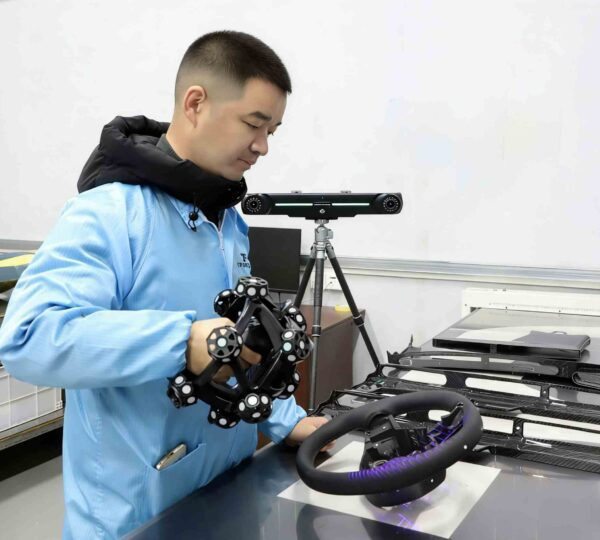
He Dong – Automotive & Motorcycle Engineering Specialist, has spent 20+ years doing what he loves most — making cars and bikes faster, sharper, and better looking.