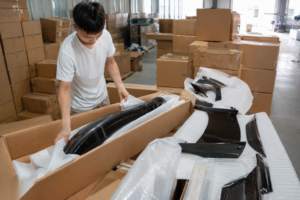
Many manufacturers want to get the advantages of carbon fiber in strength, stiffness and weight, but the high price makes them step back. So many people start to notice flax fiber.
Flax fiber is different from carbon fiber, it is not a synthetic material, but a natural fiber composite. Although the strength is not as good as carbon fiber, but the weight, sustainability and vibration damping performance are all better than carbon fiber, and the price is also cheaper.
Car brands like BMW, Porsche, McLaren already put flax fiber into real use.


So can flax fiber completely replace carbon fiber? Should you save cost and choose flax fiber? Let’s find the answer from this article.
Flax Fiber vs Carbon Fiber: Comparison Table
Comparison Item | Flax Fiber Composite | Carbon Fiber Composite |
|---|---|---|
Fiber density | about 1.4–1.5 g/cm³, lighter | about 1.75–1.95 g/cm³ |
Fiber tensile strength | about 500–1500 MPa | about 3000–7000 MPa |
Fiber elastic modulus | about 30–70 GPa | about 230–640 GPa |
Vibration damping | excellent, max can reach 5 times of carbon fiber | normal, vibration decay is slow |
Fracture behavior | ductile fracture, no shattering and splashing | brittle fracture, may produce sharp debris |
Raw material cost | low, come from renewable crops | high, depend on high energy consumption precursor and carbonization process |
Production carbon emission | low, can reduce up to about 85% | high, high temperature carbonization consume huge energy |
Moisture absorption | relatively high, need surface treatment protection | low moisture absorption, dimension stable |
Property consistency | influenced by origin and batch a lot | industrial production, consistency is high |
Typical applications | semi-structural parts, interior and exterior trim, racing car body panels, sports goods | aerospace main load-bearing structure, high performance load-bearing parts |
What Is Flax Fiber?
Flax fiber is a bast fiber extracted from the stem of flax plant, also one of the natural fibers that human used for the longest time in history.
Europe (especially France, Belgium, Netherlands) is the main production area of high quality textile grade flax in the world.
Flax growth cycle is short, need less fertilizer and pesticide, also don’t take the land of food crops, so it can be produced in large quantity, as a supply of engineering material.

How Flax Fiber Is Made
The processing of flax fiber is very energy saving.
The harvested flax stems go through dew retting or warm water retting (degumming), then use mechanical combing to extract the fiber, after that weave into plain weave, twill weave or unidirectional fabric.
Then come to the composite molding step, the fabric is combined with epoxy resin, bio-based resin or thermoplastic resin, and made into parts by vacuum infusion, prepreg autoclave or RTM process.
Flax fiber can directly use the molds and molding process of carbon fiber, factory don’t need to replace equipment or modify the production line to manufacture both materials.

Key Properties of Flax Fiber Composites
Flax single fiber properties:
- Tensile strength about 500–1500 MPa,
- Elastic modulus about 30–70 GPa,
- Density about 1.4–1.5 g/cm³
From the data, the absolute strength, stiffness and density of flax fiber are all lower than carbon fiber; the specific strength (strength/density) is equal to glass fiber or even better.
Academic research also shows, the hollow microfibril structure of flax fiber gives it excellent vibration damping and sound absorption properties, data shows its damping performance can reach max 5 times of carbon fiber composite.
Besides, flax laminate shows ductile fracture when impacted, it will not brittle shatter and produce sharp splash like carbon fiber, this property has been verified by real tests in racing cars.
📝 Note
The properties of flax fiber produced in different batches will have some difference, in the literature the coefficient of variation of flax laminate tensile strength is about 4%–16%.
For load-bearing parts with high safety level requirement, it is recommended to use unidirectional fabric or satin weave fabric, and confirm the property fluctuation through supplier batch traceability.
What Is Carbon Fiber?
Carbon fiber is a high performance synthetic fiber with carbon content more than 90%, it is the core material of aerospace and high-end industry lightweight in the past half century. For detailed introduction you can see ➡️ A Complete Guide: What Is Carbon Fiber Material and What Is It Used For?

How Carbon Fiber Is Manufactured
Mainstream carbon fiber use polyacrylonitrile (PAN) as precursor, made through many processes like pre-oxidation (200–300°C), low temperature and high temperature carbonization (1000–3000°C), graphitization, surface treatment and sizing.
The whole process need to be completed continuously in inert gas environment, energy consumption is very high, equipment investment is also big, so the cost of carbon fiber is so expensive (details in how carbon fiber is made).

Key Properties of Carbon Fiber Composites
The fiber level tensile strength of carbon fiber can reach 3000–7000 MPa, elastic modulus 230–640 GPa, density about 1.75–1.95 g/cm³.
Its specific strength and specific stiffness almost have no rival in engineering materials, at the same time it has excellent fatigue resistance, chemical corrosion resistance and very low thermal expansion coefficient.
Industrial production guarantees very good batch consistency, make it the first choice of main load-bearing structure.
But its weakness is also obvious: brittle fracture mode, conductivity along the fiber direction (contact with metal may cause galvanic corrosion), not transparent to radar and radio signal, and extremely high production carbon footprint.
Flax Fiber vs Carbon Fiber: Head-to-Head Comparison
Strength and Stiffness
On absolute strength and stiffness, carbon fiber keeps the overwhelming advantage, the tensile strength of carbon fiber laminate level is generally 3–5 times of flax system.
For extreme load-bearing scenes like aircraft wing, F1 monocoque, high pressure hydrogen storage tank, carbon fiber is no doubt irreplaceable.
But if convert to specific stiffness and cooperate with structure optimization (such as grid rib design), flax composite can achieve equivalent stiffness and weight with carbon fiber parts on semi-structural parts, this point has already been proved in racing field long time ago.
Weight and Density
Flax fiber density is about 1.4–1.5 g/cm³, lower than carbon fiber’s 1.75–1.95 g/cm³, and much lower than aluminum alloy.
In plate and shell parts, natural fiber replacing traditional injection plastic solution can achieve weight reduction up to about 50%; compare with carbon fiber parts, the weight is almost same, or slightly heavier, the weight difference depend on layup design.
Vibration Damping and Acoustic Performance
Vibration damping is the most unique advantage of flax fiber. The microfibril structure of natural fiber and the fiber-matrix interface can dissipate vibration energy more efficient, part level test shows its damping performance can improve more than 250% compare with carbon fiber solution.
This have very high value for automotive interior NVH, sports equipment hand feeling (racket, snowboard, bicycle frame) and precision equipment vibration isolation.
Besides, the damping of the combination of flax fiber and carbon fiber is also about 20% higher than pure carbon fiber solution, it is a compromise solution combining performance and comfort.
Cost Comparison
Flax raw material come from large area planted crops, the price is far lower than PAN precursor; the processing don’t need high temperature carbonization, energy cost is low.
Overall speaking, the production cost of flax fiber reinforced composite is obviously lower than carbon fiber composite (CFRP), and can directly reuse the existing carbon fiber molds and production line, the switching cost is controllable.
But need to pay attention: the supply of high quality engineering grade flax fabric is relatively concentrated, when purchasing in small batch it don’t have so much price advantage; compare with aluminum alloy and steel, its cost is still high.
Sustainability and Carbon Footprint
Flax fiber is after all a natural fiber, so in sustainability aspect it is far better than carbon fiber.
Flax fixes carbon during growth, processing energy consumption is low, the carbon emission produced by flax fiber in production process can be reduced up to about 85% compare with carbon fiber; BMW public data shows, only changing the roof from CFRP to flax fiber composite, the CO2 emission of this part’s production process can reduce about 40%.
On disposal, natural fiber parts can achieve energy recovery through normal waste incineration power generation, part of them can also be recycled and reproduced.
But the recycling of carbon fiber composite is still an industry difficult problem until now, large amount of scrapped parts can only be landfilled.
Applications: Where Each Material Wins
Automotive and Motorsports
Automotive is the fastest commercialization field of flax fiber composite, because flax fiber price is slightly lower and it don’t shatter and splash in collision.
Professional racing like F1 (McLaren), Formula E (BMW iFE.20 cooling air duct), Porsche 718 Cayman GT4 all used flax fiber whole car kits, many brands’ mass production car lines also use flax fiber as roof and interior material.
But on the parts with extremely high strength requirement like car body main structure and chassis load-bearing parts, carbon fiber is still irreplaceable.


Sports and Consumer Goods
Flax fiber damping is good, hand feeling is also good, so it is often used on some sports equipment, for example snowboard, surfboard, tennis racket, kayak.
Carbon fiber is often used on sports equipment with high stiffness requirement, for example fishing rod, racing grade road bike frame, rowing oar and golf club.


Aerospace and High-Performance Engineering
Aerospace is still the home field of carbon fiber, spacecraft wings, fuselage sections, satellite load-bearing structures all have extremely high requirement on stiffness, fatigue life and property consistency between different batches, currently only carbon fiber can satisfy.

Pros and Cons of Flax Fiber and Carbon Fiber
The logic of material selection will be more clear when put the pros and cons of the two materials together:
Flax fiber pros
Renewable and low carbon (max emission reduction about 85%), low raw material cost, excellent vibration damping, safe fracture without splashing, radio frequency transparent, parts can do energy recovery
Flax fiber cons
Absolute strength and stiffness relatively low, high moisture absorption need protection, big batch scatter, limited temperature resistance upper limit, engineering grade supply chain still growing
Carbon fiber pros
Top level specific strength and specific stiffness, fatigue resistance and corrosion resistance, high batch consistency, extremely low thermal expansion coefficient, fully verified in main load-bearing structure
Carbon fiber cons
Expensive price, high production energy consumption and carbon emission, brittle fracture produce sharp debris, difficult to recycle, conductive and shield radio signal
Can Flax Fiber Replace Carbon Fiber?
The answer is: flax fiber cannot completely replace carbon fiber.
On interior parts, exterior panels, secondary load-bearing structure, energy absorbing safety parts and sports equipment, flax fiber composite indeed can replace carbon fiber in some scenes; but in more scenes with higher requirement, carbon fiber is still the only choice.
💡 Pro Tip
When selecting material, first ask three questions: does this part bear extreme load? Is there vibration damping or NVH index? Do regulations have requirement on carbon footprint? The three answers will directly guide most projects to the correct material, if necessary then consider hybrid solution.
FAQ
Not sure which process fits your project?
Send us your part drawings or a sample
Our engineering team will review it and recommend the most cost-effective route.
Decided carbon fiber is the right call? Browse our carbon fiber body kits & aero packages, or look up your vehicle in the brands & models directory.
Want to keep reading? Browse the full Resource Center for more articles, installation guides, and pricing insights from the factory.
Author: He Dong
He Dong – Automotive & Motorcycle Engineering Specialist, has spent 20+ years doing what he loves most — making cars and bikes faster, sharper, and better looking.