Quick answer: Forged carbon fiber is real carbon fiber — chopped strands compression-molded in resin instead of woven into fabric.
It’s not fake, not a print, and not automatically stronger or weaker than woven carbon. It’s a different material format with different strengths: woven wins on directional performance and classic looks; forged wins on complex shapes, multi-directional behavior, and that unmistakable marble pattern.
Here’s the full forged carbon fiber vs woven breakdown — fiber form, mechanical data, manufacturing, cost, and which one actually belongs on your build.

What Is Forged Carbon Fiber?
Forged carbon fiber (also called forged composite) was popularized by Lamborghini and Callaway around 2010 for the Sesto Elemento program. The process abandons weaving entirely:
- Carbon fiber is chopped into short strands (typically 10–50mm)
- The strands are mixed with resin into a moldable compound
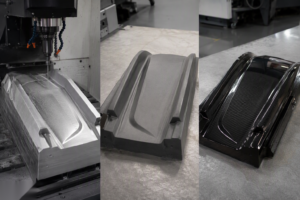
- The compound is placed in a matched metal mold and compression-molded under high pressure and heat
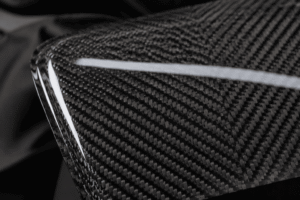
- The cured part emerges with a random, marbled surface — no two parts ever look identical
That randomness is the signature. Where woven carbon shows an ordered grid, forged carbon shows flowing, stone-like patterns with fiber fragments catching light at different angles. It reads as something between carbon fiber and black marble.
What Is Woven (Regular) Carbon Fiber?
Woven carbon fiber is the classic material: continuous carbon filaments woven into fabric — 2×2 twill, plain weave, satin weave — then layered into a mold with resin and cured via autoclave, oven, vacuum infusion, or RTM.
Its defining advantage is controlled fiber orientation. Engineers can aim continuous fibers exactly along the expected load paths. Its defining aesthetic is the ordered motorsport weave that has signified “lightweight and serious” for three decades.
Forged Carbon Fiber vs Woven: The Data Comparison
Factor | Woven Carbon Fiber | Forged Carbon Fiber |
|---|---|---|
Fiber form | Continuous woven fabric / UD / prepreg | Chopped strands in resin, compression molded |
Fiber orientation | Controlled and directional (0°/±45°/90°) | Random, quasi-isotropic |
Density | ~1.5–1.6 g/cm³ | ~1.6–1.8 g/cm³ (typically higher resin fraction) |
Tensile strength | ~600–1,000 MPa (optimized laminates, directional) | ~400–800 MPa (more uniform in all directions) |
Behavior off-axis | Weak away from fiber direction | Consistent regardless of direction |
Complex 3D shapes | Difficult — fabric distorts on tight curves | Excellent — compound fills detailed molds |
Appearance | Ordered weave, repeatable | Random marble, unique on every part |
Cutting waste | Fabric offcuts from nesting | Low — material fills the mold |
Typical uses | Hoods, wings, splitters, diffusers, panels | Mirror covers, interior trim, steering wheels, small complex parts |
Forged Carbon vs Weave: Which Is Stronger?
The honest answer: it depends on the load direction, and neither wins universally.
Woven carbon wins when the load path is known. Continuous fibers placed along the stress direction deliver higher tensile strength and stiffness — a well-engineered twill or UD laminate reaches 600–1,000 MPa in its design direction. This is why structural parts (hoods, wings, chassis components) stay woven.
Forged carbon wins when loads come from unpredictable directions or the geometry is too complex for fabric. Its random fiber distribution gives it quasi-isotropic behavior — no weak “against the grain” direction. The interlocking chopped fibers also resist crack propagation, which is why forged parts tend to absorb localized impacts without the clean shatter a thin woven laminate can suffer.
The trap to avoid: a poorly made forged part with low fiber content will underperform a properly laid woven part — and vice versa. Fiber volume fraction, resin system, molding pressure, and cure quality decide real-world strength far more than the forged-vs-woven label. Beware cosmetic “forged look” parts that are hydro-dipped prints over fiberglass — genuine forged carbon is molded, not printed.

Manufacturing and Cost Differences
Woven carbon production is labor-heavy at the layup stage: fabric cutting, ply alignment, resin infusion or prepreg handling, then curing. Complex curves fight the fabric. Visible-weave parts demand near-perfect alignment, which raises rejection rates.
Forged carbon production is mold-centric: once the compression tooling exists, cycle times are short and shapes can be highly complex — deep ribs, tight corners, integrated mounting features that woven fabric simply can’t form. Tooling cost is higher upfront; per-part cost drops fast at volume.
Cost Factor | Woven | Forged |
|---|---|---|
Tooling investment | Low–medium (single-sided molds common) | Higher (matched compression molds) |
Labor per part | High (hand layup, weave alignment) | Low (charge, press, demold) |
Material waste | Moderate–high (fabric offcuts) | Low |
Sweet spot volume | Low–medium | Medium–high |
Small decorative part price | $$ | $$–$$$ (premium positioning) |
Neither is universally cheaper. A forged accent piece can cost less to produce at scale than a woven one — and more at prototype quantity. Volume and geometry decide.
Which One Belongs on Your Car?
Choose woven carbon fiber when:
Choose forged carbon fiber when:
Mixing both? It works best when each material has a clear role — woven on the big aero panels, forged on the detail pieces. Repeat each finish at least twice on the car so the mix reads as intentional.
FAQ
Forged carbon fiber — frequently asked questions
Common questions about forged carbon versus woven carbon fiber.
The Bottom Line
What is forged carbon fiber? Real carbon, different format: chopped strands compression-molded into complex shapes with a one-of-a-kind marble surface. Forged carbon fiber vs woven comes down to the job — woven for large structural panels and classic looks, forged for complex geometry and standout details. Buy the engineering, not the pattern.
Whether your build calls for classic twill or a forged marble finish, JC AUTOCARBON manufactures both — from mirror covers to full carbon fiber hoods.
Author: He Dong
He Dong has spent 20+ years doing what he loves most — making cars and bikes faster, sharper, and better looking.
As an Automotive & Motorcycle Engineering Specialist, he’s worked on everything from engine builds and chassis tweaks to track machines and custom aftermarket projects. If it has wheels and an engine, he’s probably taken it apart and made it better.
These days he focuses on the aftermarket world, where good engineering meets real-world budgets — and he’s not shy about calling out parts that look great in photos but don’t perform.
This blog is where he shares what’s worked, what’s failed, and what he’s learned along the way. Honest, hands-on advice, straight from someone who’s done the work himself.